Servicing: what ‘little and often’ means today
MG servicing is simple and can be best described as ‘little and often’, rather than the almost ‘fit and forget’ of modern cars. However, the workshop manuals’ time/mileage maintenance schedules are quite out of kilter today, as the first level of service is listed as every 3,000 miles or every three months, but with the mileage patterns of the cars today 3,000 miles can be two or more years for some.
The other aspect that many fail to appreciate is that when the service interval is due at 3,000 miles or three months, it should be interpreted as whichever of those parameters arrives first. Today it does absolutely no harm to continue to do the lubrication service every three months, but on very low annual mileage cars I would suggest that the service routine can be extended to once every 12 months.
There are many more detailed lubrication points on a classic MG than on a modern car, and reference to the workshop manual for the list of routine lubrication points will show what needs to be addressed on your specific MG model and its age.
Engine oil: why classic pushrod engines need ZDDP
Engine, gearbox and axle servicing will be the areas most owners are already focussed on. Starting with the engine, there is a demand today to use a lubricating oil that is blended specifically for our classic cast iron overhead valve pushrod engines, which have a number of lubrication requirements based on the design and materials used in these engines. Probably the highest profile aspect relates to lubricating what are called ‘flat tappets’, which are camshaft followers that have a flat base in contact with the camshaft lobes, and this creates very specific and high load operating conditions that are different to those in a modern twin overhead camshaft all alloy engine.
Specifically, oil blended for a classic pushrod engine contains an additive called ZDDP that provides protection for those ‘flat tappets’, and so is added at a higher concentration than is found in oil blended for modern engines. In the modern engine ZDDP damages exhaust catalysts and, as it is not needed in the same quantity, that is why it has been reduced in the oils for modern engines.
In North America, when these levels were reduced, it created quite a public debate within the classic car community, with unfortunately a fair degree of inaccurate comment, as the prospect of rapidly wearing engines was viewed with considerable concern. Fortunately, real issues have been considerably fewer than the doomsayers’ predictions. In Europe the same path has been followed, but without the same degree of inaccurate discussion and with a wider acceptance of a simple approach: use an oil suitable for your classic pushrod engine, and choose one that has been blended to suit our classic engines, such as Castrol Classic XL 20W/50.
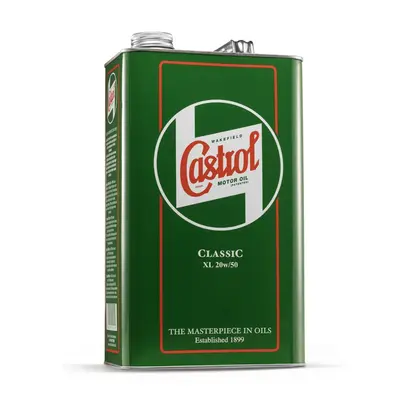 1925 - Castrol Classic XL20W/50 1 Gallon
20W/50 multigrade engine oil was the most commonly used in the 1960s and 70s, although with the increase in lower viscosity oils in the later 1970s MG extended approval down to 10W/40 oils for normal UK climatic conditions. It is important to note that they clarified this by adding that the oil should be to API SE spec, which was very specific to that period; a 10W/40 oil today will have a much higher API spec, but its blend may not be suitable for a classic engine.
Oil filters and service kits
When you change your engine oil it always makes sense to also change the oil filter, and there are various different configurations of filter depending on the age of your MG: a replaceable paper element in earlier MGs, which was replaced by the more convenient spin-on cartridge in the early 1970s. As an engine service will include other aspects, such as renewing the points and condenser and checking and adjusting the valve clearances, which means removing the rocker cover and so needing a new gasket, it makes sense to make use of one of MGOC Spares’ ‘12,000 mile service kits’. These provide the essentials for an engine service, including the parts mentioned plus four new spark plugs, a pair of air filter elements and a small bottle of SU damper oil, with perhaps additional parts subject to the specific vehicle.
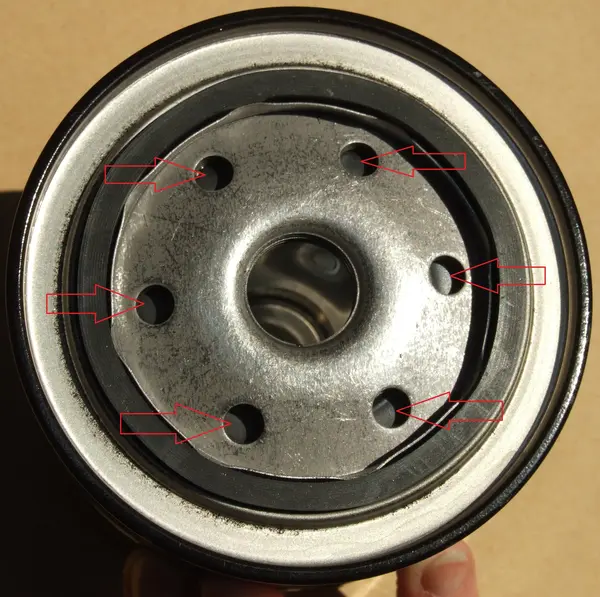 Typical later replacement cartridge type oil filter (GFE121 displayed above). The rubber seal should be given a light coating of fresh oil before fitting, to prevent the seal sticking and possibly distorting.
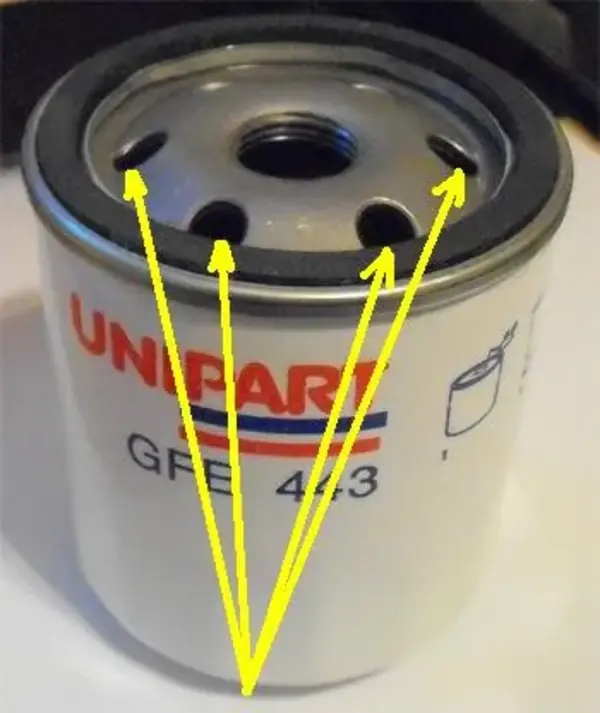 For the MGB, which has its filter fitted in an upside down position (GFE166), ideally the filter should have an ‘anti drain back’ control. This is simply a rubber flap that closes off the visible holes in the filter (four arrowed): pressurised oil can push past these flaps, but when pressure drops off with the engine switched off the flaps prevent oil draining back to the sump from the filter. This reduces the time without oil pressure at the next cold start.
How much oil? Capacities, oil coolers and the MGB dipstick oddity
How much oil you add to your engine obviously varies with which MG and which engine is fitted, and you should refer to your workshop manual for that volume, but there are a couple of specific points to be made here. The first relates to engines with oil coolers, predominantly the MGB. When draining the engine oil, the cooler and its hoses will not drain, so there will always be about half a pint of oil retained. This will not be a problem and, whilst it will contaminate the fresh oil more than on an engine that doesn’t have an oil cooler, it has never caused a problem. Perhaps when bringing back a car that has been off the road for many years and giving it its first oil change you should use a flushing agent before draining, and then change that fresh oil again after only a few hundred miles, once it has had the opportunity to clean the inside of the engine.
An oddity applies to the MGB, where the same 1798cc B series engine was used from 1962 to 1980. Aside from the changes in late 1964, when the three main bearing engine was replaced with the redesigned five main bearing engine, which included a change of shape of the block that dictated a change of sump, the five main bearing sump continued all the way to the end of MGB production in 1980. For the sharp eyed, reading through different model year workshop manuals shows that the sump capacity was originally listed at 4.26 litres, yet by the issue of the 1978 model year’s updated workshop manual this had reduced to 3.4 litres.
Looking at the parts lists shows that the original 1962 dipstick and tube were retained until 1969, when both dipstick and tube were changed with the 18GG series engines. A further change of dipstick occurred just after the start of the 18V series engines, and there was no further listed change of either dipstick or tube all the way to the end of production. It is therefore reasonable to assume that the markings on the 18V-on (straight rather than cranked) dipstick were also changed to cater for the reduced sump oil volume.
Oil leaks: when a drip becomes a fault
Oil leaks from old engines are an almost inevitable characteristic of classic MGs, but these should amount to no more than a need to put a drip tray under the engine where it is normally parked, to catch the occasional drip. Once a leak progresses to a puddle that grows to an inch or more in diameter after using the car for more than half an hour, it should be looked upon as a fault requiring rectification. There can be a number of reasons behind an engine oil leak: from something as simple as a sump gasket having compressed over time and use, leading to sump bolts that are no longer fully tight and which just need nipping up to stop a leak; through a clogged engine breather that is pressurising the crankcase and forcing oil out; to a generally worn engine that is in need of a rebuild.
SU damper oil
The damper oil is added to the SU carburettor dashpots and is a very light oil. In new or fully rebuilt carbs this tends to see the level in the dashpots not drop that fast, but many well used engines with carbs that have covered the mileage the engine has covered seem to lose this oil quite quickly. With decades of hands on experience, I have often changed the damper oil for engine oil, which is much thicker and tends not to get drawn into the engine and burnt as fast as the SU damper oil, and the added thickness also slightly reduces the speed of the piston rising, which is also often helpful in reducing a slight hesitation that can occur when initially opening the throttle to accelerate. Note that if you do find using engine oil in the carburettor better, you can still use the SU oil for your locks, hinges and other pivot lubrication covered in part two.
Gearbox oil: engine oil, EP90 and why GL4 matters
The traditional oil used in BMC designed manual gearboxes, such as those attached to the A and B series engines, was almost always the same oil as used in the engine. Notable exceptions in the popular classic MG ranges are the MGB GT V8, where the modified MGB/C gearbox oil spec moved to EP90 gear oil as a means of coping with the V8 engine’s torque; the overdrive’s internal pressure relief valve and clutch disengagement spring specs were also changed to suit. The other example was the Midget 1500, where its Triumph heritage saw it carry over the same gear oil as used in the V8.
This gear oil was the Extra Pressure EP90, but today this has been superseded by multigrade versions such as 75W/90 or 80W/90. It is important to use only a GL4 spec (not GL5) to ensure that the oil’s make-up doesn’t contain any additive that could damage some of the gearbox’s internal ‘yellow’ (brass) components.
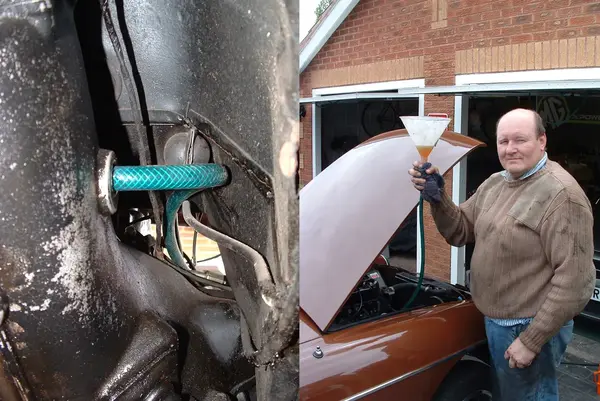 Gearboxes using engine oil demand more frequent oil changes. Using a long garden hose from the gearbox to outside, where a funnel allows easy pouring, also means that any drips stay outside the car. This is a later MGB with the later combined side filler/level plug, but the same hose can be used for the earlier gearboxes with the combined dipstick/filler point at the top of the gearbox.
Rear axle
The rear axle also uses the same EP90, so it is subject to the same provisos as apply to the gearboxes that use the same oil. Today that means using a multigrade gear oil such as 75W/90 or 80W/90, and ensuring it is only to GL4 specification in deference to the age of the axle and its internal materials.
Steering rack: oil, not grease
Early MGBs had a lubricating nipple at the pinion end of the steering rack, and I describe this as a lubricating nipple rather than a grease nipple because, whilst it looks like and is the same fitting, it is not for adding grease but for adding the same EP90 gear oil as mentioned above, and the same provisos once again apply to the use of 75W/90 or 80W/90 multigrade gear oils to GL4 specification.
There are a couple of ways to add fresh gear oil into the rack. If it has a lubricating nipple, one way is to use a grease gun loaded with gear oil, but as most will not have this facility, probably the least invasive will be to raise one side of the car as high as is practical with your facilities, undo the small outer steering rack boot clip, turn the steering to extend that specific boot, and use a syringe or oil can loaded with gear oil to pump some in.
Note that a dry rack needs only a third of a pint (approx. 190ml), and only if the rack’s operation is rough or noisy should you add this amount. Where rack function is smooth and quiet, then only add about 100ml before refitting the boot clip or fitting a new one. The added oil will at this time be sitting in the boot and will need to be encouraged into the rack. Raising the car on that side will see gravity helping oil into the rack, and slowly turning the steering the opposite way will gently start to compress the boot and add a little pressure on the oil to move it into the rack a little faster. Don’t be a ‘bull in a china shop’ and turn rapidly to full lock, otherwise you will force oil out past the boot ends: small movements over a few minutes are what is needed.
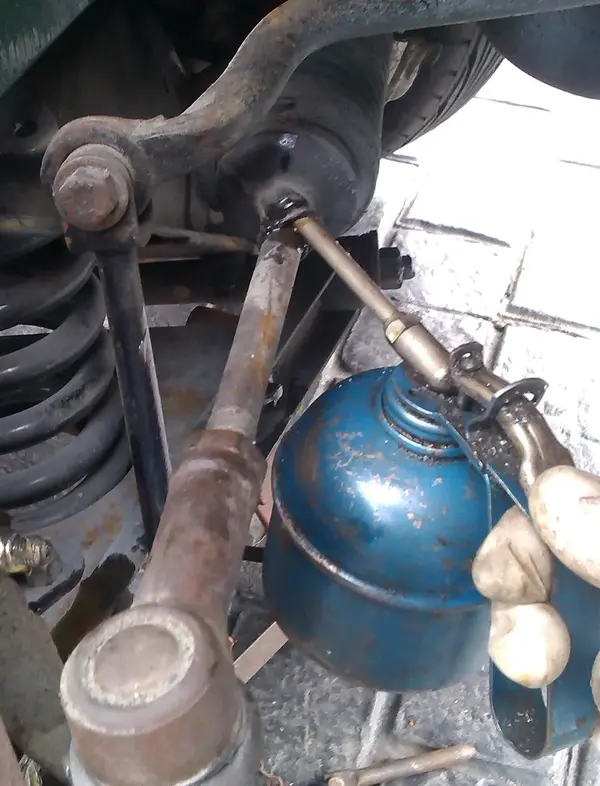 Adding gear oil to a steering rack using a small pump type oil can, with that side of the car raised as high as possible.
In part two we look at greasing the suspension and running gear and the smaller oiling points that are easily forgotten.
Related reading
See our full range of Classic MG Parts here. For further information contact our helpful sales advisors by phone on +44 (0)1954 230 928 or email at sales@mgocspares.co.uk.
Please Note: The information provided in this blog is intended as a general guide only. While we aim to ensure accuracy, classic vehicles can vary, and procedures may differ depending on model and condition. Always consult your vehicle’s official workshop manual before carrying out any work. If in doubt, seek the services of a qualified professional.
© 2025 MGOC Spares Ltd. All rights reserved.
This blog and its contents are the intellectual property of MGOC Spares Ltd and may not be copied, reproduced, or republished without prior written permission.
For author enquiries, corrections, or reproduction requests, please contact: blog@mgocspares.co.uk
Meet Roger Parker – our MG “Tech Guru” with a lifetime of passion for all things MG!
From his early experiences with MGs, to a career as a traffic officer developing ANPR systems, advising MG Rover and then as a technical advisor & writer at the MG Owners’ Club – Roger has worked on hundreds of MGs. Now, in “retirement,” he shares his unrivalled knowledge with us at MGOC Spares.
His blogs (exclusive & free!) are packed with expertise you won’t find anywhere else.
View more here
Who are MGOC Spares?
At MGOC Spares, we provide dedicated parts and accessories for classic MG vehicles, including the MGB, Midget, MGC and many more.
With thousands of products in stock, we are your one-stop shop for all your classic car needs. Our wealth of expertise means that you can trust us to find the right part for your classic MG vehicle – whatever it may be.
Need support finding the right parts for your MG?