Part one of a two-part guide to brake and clutch hydraulics on classic MGs. This first part covers fluid types, specifications, safety, identification and service life. Part two covers the practical bleeding procedures for both single and dual circuit systems, plus the clutch.
For decades now when a car was assembled on the production line it came to a point when it was time to fill the various fluid systems with appropriate fluids, brake, clutch coolant, power steering and air conditioning being the common ones. The need for this to be done quickly and efficiently saw that all these would be done at one station by way of a very efficient vacuum fill process, where the systems would have the air inside the systems ‘sucked out’ and the appropriate fluid then allowed in to replace the removed air in one simple automated process that then avoided any need for subsequent bleeding air out of the system. See the image of an MG ZT 260 having all system fluids being added on the Longbridge production line in 2004.
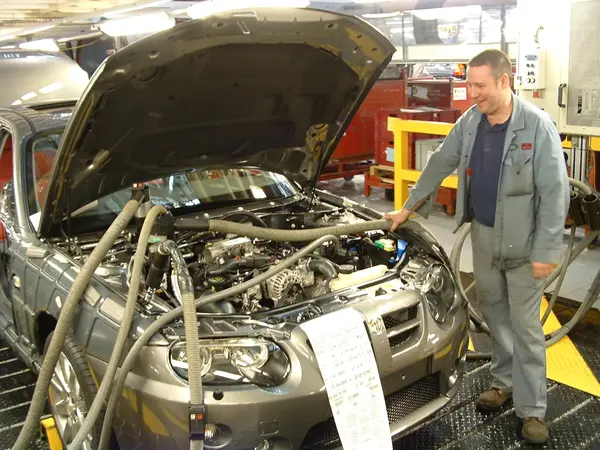 MG ZT 260 on the Longbridge production line, all system fluids being added
Most owners though don’t have the facility of expensive intelligent automated powered systems that just need attaching to the engine bay fluid fill points, although vacuum bleed and fill for the brake and clutch system servicing is certainly found in many garages and some pieces of equipment are cheap enough to fit in the keen mechanic owners workshop. However vacuum and pressure bleeding kits for cars hydraulic systems have been around for many years and are well within the budget of classis MG owners.
Firstly why do we have to consider servicing brake and clutch hydraulic systems? The answer is simple and related to the operating conditions found within our cars brake and clutch hydraulic systems, which dictates the characteristics of the fluid that is used within them. Indeed starting with the very basics sees the use of a fluid simply because it can very easily be piped around the nooks and crannies of the car to transfer the energy that the driver imparts on the brake pedal to the braking components at each wheel to activate those braking parts to slow the car down.
Fluid also doesn’t compress like air so it can act like a solid bar with pressure input at one end being applied at the other, but then some fluids compress more than others just to complicate matters. Another consideration is that the operation of the brakes creates friction that turns the motion of the car into heat energy and that can be quite considerable and get into the fluid, which creates more constraints on that fluid. Finally in this resume of operating conditions the fluid must not create adverse degrading conditions for the pipes and braking components it is in contact with.
For decades the common brake fluid has been a Glycol Ester fluid although Citroen created their Liquide Hydraulique Mineral, (LHM) oil that was also used by Rolls Royce for a period, and then in the 1970’s Silicone fluids appeared but neither fluid had any significant aspect on the very wide use of the Glycol Ester fluids by the majority of the worlds car makers.
At this point most owners will be aware that the common glycol ester fluids found under DOT3, DOT4 and DOT 5.1 specifications is a very effective solvent and will seriously damage cars paintwork, clear coat lacquer and some plastics, if allowed to come into contact with these materials. Great care is needed to avoid spills but before opening any container with this type of brake fluid have to hand a watering can or similar full of clean water, so that any spills of brake fluid can be immediately drowned in water to reduce the potential damage.
The common descriptive term for the mainstream fluids is with their DOT number, the US certification that is the common quality standard and relate to the tested performance of each fluid. This standard primarily relates to the dry and wet boiling point for the fluid, dry being with no water content and wet with no more than 3.7% water by volume. The importance of the water content is twofold; firstly Glycol ester fluids are hygroscopic meaning they attract and absorb moisture from the atmosphere that lowers the boiling point of the fluid, and secondly that with braking heat if the lowered boiling point of the fluid is exceeded then the water will boil out and create a vapour bubble, and as gasses are compressible when fluids are not means that the bubble will compress and can cause the brake pedal to sink to the floor and you lose braking.
Going back fifty plus years and the common brake fluid in our MGs was DOT3 that continued in use for many decades (and remains available today). Today the mainstream fluid found in almost all vehicles has moved onto DOT 4 fluid that arrived pre millennium and was often mandated from the early 2000’s, whilst on some very high performance vehicles even higher performing DOT 5.1 is specified.
Silicone brake fluids carry DOT 5, and the obvious point here is that the DOT numbers appear to indicate the fluids are all related, but critically they are not. DOT 5 silicone fluids must NEVER be mixed with any of the glycol based DOT 3, DOT 4 or DOT 5.1 fluids as they are incompatible with each other, and mixing over time will create a jellified mess that impinges on braking.
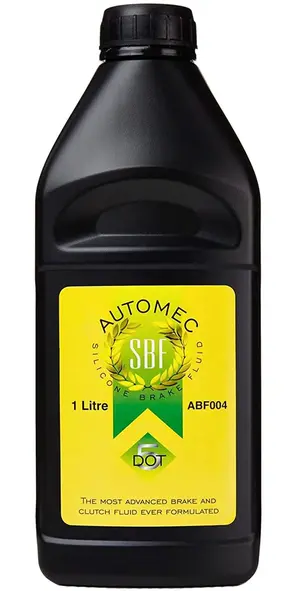
Automec Silicone Brake Fluid
If you do not know the type of fluid in a classic you may have recently bought then the simplest way to confirm is to get a small quantity of fluid, a spoon full is enough, and put it in a clean dry glass jar. Now add about a tea spoon full of water into the fluid and put the lid on the jar. Shake the jar to mix the fluids and leave a few minutes to settle and then examine the contents to see if the fluids have mixed, which if they have indicates a glycol ester fluid (DOT 3, DOT 4 or DOT 5.1), but if the water and fluid hasn’t mixed and can still clearly to be seen as separate elements like an oil/water mix, then you have silicone fluid (DOT 5). (In some jurisdictions fluid colour is mandated with clear to amber for glycol ester and purple for silicone, but the mixing test is more reliable.)
When looking at DOT 3, DOT 4 and DOT 5.1 they are all compatible with each other so can be safely mixed, although the general principle is that you would not want to use a lower DOT number fluid when your cars system is using or recommended to use a higher DOT number as the fluid performance will be degraded, although old water contaminated higher DOT number fluid may well have a poorer performance than new lower DOT number fluid! Today with DOT 4 having been the mainstay for so many years and refreshed many DOT 3 systems, so for most DOT 4 will be the fluid to use.
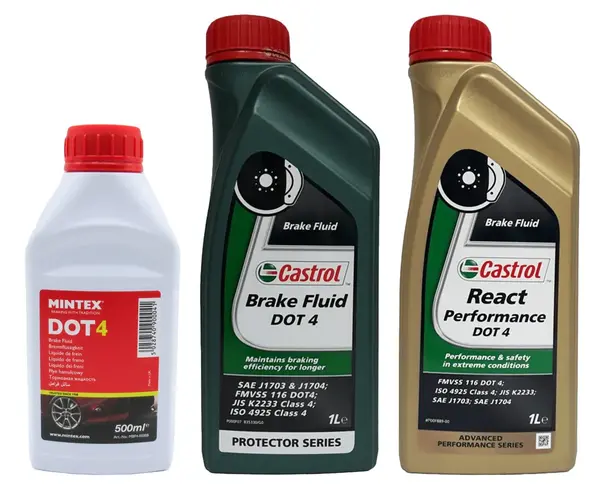
Left to right: Mintex DOT4 | Castrol DOT4 | Castrol Performance DOT4
That need for regular fluid replacement is simply because the Glycol Ester based fluids are as mentioned Hygroscopic and their propensity to absorb water is clear from the identification test mentioned above, but in service the water comes from the atmosphere. Atmospheric water vapour will primarily enter brake fluid via the very small breather hole that has to be present in the master cylinder cap and it then spreads throughout the rest of the fluid in the system. Water in the fluid will cause corrosion to the pipes and other parts it is in contact with and can hugely affect braking performance, when the heat generated is enough to boil the water out of the fluid that creates a gas bubble that can be compressed and so the brake pedal can sink to the floor!
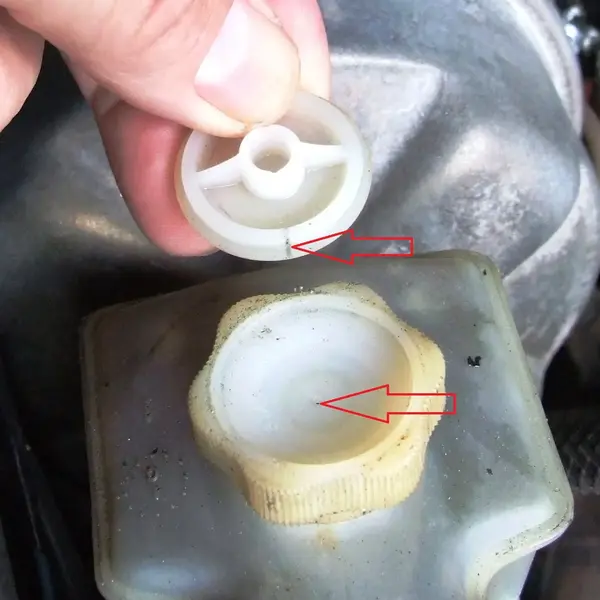 Master cylinder cap, top section unclipped, arrows indicating the air bleed hole and slot
As far as classic MGs are concerned the recommended change point for brake fluid is only listed for the later MGB and Midget 1500 North American market cars every 18 months, (or oddly 19,000 miles). The factory manual goes on with a recommended renewal of all brake and clutch system seals and hoses every three years, (or again oddly 37500 miles), and obviously with a fluid change. Note that these factory recommendations reflect the generally lax views of the period the publications were printed, as we see them today, so for earlier cars there was simply a note to check fluid levels in the master cylinder and visually check the pipes and hoses for damage, with checking and adjusting the mechanical braking parts.
As history confirms there was no great problems with the lack of regular routine fluid changes, mainly because even with fluid elevated water content of over 3.7% by volume, (the highest water content level used in the DOT testing over which is ill advised), brakes were rarely used hard enough to generate enough heat to see water content boil. This is perhaps as well as today few cars have regular fluid changes, but at least now we do have the availability of testers to check water content in brake fluid that should be a part of a keen owner’s tool chest. MGOC Spares offers a proven Gunson’s tester, but be wary of the accuracy and reliability of some advertised from under £5.
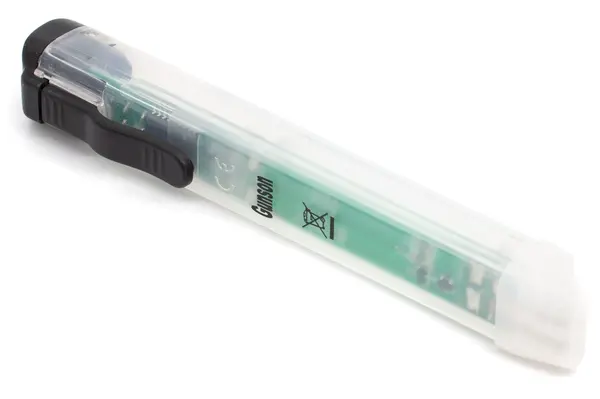
Z018 - Gunson Brake Fluid Tester
Coming in Part 2: Bleeding Classic MG Brake and Clutch Hydraulic Systems, which covers the practical procedures for single and dual circuit braking systems, one-man bleed kits, the silicone fluid debate, and the clutch hydraulic system.
See our full range of classic car components here. For further information contact our helpful sales advisors by phone on +44 (0)1954 230 928 or email at sales@mgocspares.co.uk.
Please Note: The information provided in this blog is intended as a general guide only. While we aim to ensure accuracy, classic vehicles can vary, and procedures may differ depending on model and condition. Always consult your vehicle’s official workshop manual before carrying out any work. If in doubt, seek the services of a qualified professional.
© 2025 MGOC Spares Ltd. All rights reserved.
This blog and its contents are the intellectual property of MGOC Spares Ltd and may not be copied, reproduced, or republished without prior written permission.
For author enquiries, corrections, or reproduction requests, please contact: blog@mgocspares.co.uk
Meet Roger Parker – our MG “Tech Guru” with a lifetime of passion for all things MG!
From his early experiences with MGs, to a career as a traffic officer developing ANPR systems, advising MG Rover and then as a technical advisor & writer at the MG Owners’ Club – Roger has worked on hundreds of MGs. Now, in “retirement,” he shares his unrivalled knowledge with us at MGOC Spares.
His blogs (exclusive & free!) are packed with expertise you won’t find anywhere else.
View more here
Who are MGOC Spares?
At MGOC Spares, we provide dedicated parts and accessories for classic MG vehicles, including the MGB, Midget, MGC and many more.
With thousands of products in stock, we are your one-stop shop for all your classic car needs. Our wealth of expertise means that you can trust us to find the right part for your classic MG vehicle – whatever it may be.
Need support finding the right parts for your MG?