
What is a Chassis Number (AKA frame number or car number) is the first question and in simple terms it is an individual number stamped into a cars chassis, although for most classic MGs this was only stamped into an approximately three inch by one inch alloy plate with black pre-printed lettering. (Note MGA and earlier tended to use square plates.) This dates back to when cars were built on a strong steel frame with a separate body that had its own individual number, but also separate numbers for a selection of mechanical components including engines.
From 1967 and until 1976 the MGB, C and V8 also had another number stamped into an additional and similar alloy plate with red pre-printed lettering with the title of ‘Commission Number’. I have to make the point here that this is NOT the chassis number and effectively only an internal audit number as cars were then manufactured at several different factories and only subject to final assembly at Abingdon. I have to stress the point that this is not a Chassis number and so is not the main vehicles identity number.
In the hierarchy of the numbers the chassis number was and remains the most important one as this was and remains the main and specific identity number of the car and that is the number that still does carry most weight in respect of that cars identity, it’s even more important to the cars identity than the registration number, as registration numbers can be changed whilst the chassis number remains the unchanged and core identity number.
With the youngest classic MG approaching fifty years of age and many more being much, much older and the reasonable potential for so many changes to have been done to the cars, this is why MGOC Spares doesn’t request VRNs from owners when they are ordering parts, instead asking for the chassis number and often also asking leading technical questions, such as ‘Where is your overdrive switch located, Do you have a mechanical or electric fan’ etc., to establish specification, even where it differs from the vehicle’s registered year. After all, the mechanicals rarely lie!
The format of multiple numbering was quite appropriate for cars that were built in this way but when unitary construction (integrated chassis and body as one assembly) started to appear in the 1950’s that pretty much replaced the separate chassis by the 1970’s it wasn’t so appropriate and why in 1979 a new VIN (Vehicle Identity Number) system with more characters/numbers appeared in its place, and it has to be said it gave more detail too.
MGA
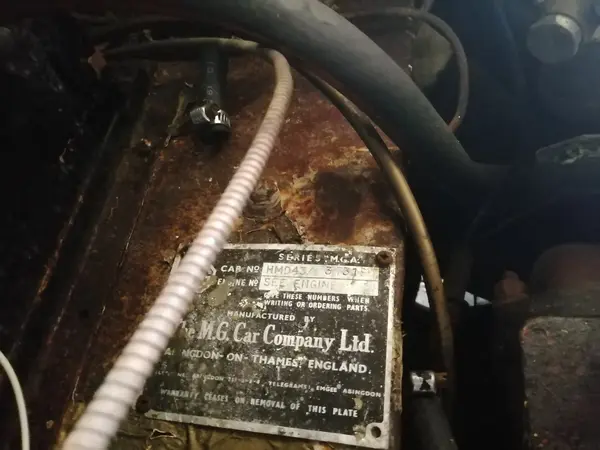 MGA chassis number plate, on heater bulkhead.
The MGA was introduced in 1955 and was built with a separate chassis and body so the use of separate chassis and body numbers was appropriate. At launch there was only a single 1489cc open top model and so a typical chassis number that still followed the Nuffield chassis numbering system would on a UK market right hand drive car would read HDA13/12345 This can be interpreted as follows…
H = MGA
D = open two seater
A = colour black
1 = right hand drive UK home market
3 = cellulose paint (type of paint)
12345 = the cars individual ID number
This original system provides detail of the car as it was originally built so there can be a number of variations to the above sequence starting with the 1956 introduction of the Coupe when the second letter D was changed for an M.
The third letter relates to the original exterior colour the car left the factory with and so there can be quite a number of alternatives as below…
A = Black
C = Red (only early cars)
D = Blue (early cars)
E = Green (early cars)
K = Light Red (from 1956)
L = Light Blue (on roadsters from 1956)
R = White
T = Light Green (from 1956)
H = Primer of CKD (export kits) finish
The first number in the chassis number prefix of HDA13 indicates the cars general market specification with the following options for different markets…
1 = Right hand driver UK Home market
2 = Right hand drive export
3 = Left hand drive export
4 = Left hand drive North American market
5 = Right hand drive CKD export (Completely Knocked Down i.e. a kit)
6 = Left hand drive CKD export
The third letter in the main chassis number prefix HDA13 shows the paint type and will almost always be found with the 3 as cellulose paint was the standard paint material, but if the car was a CKD car or left the factory in primer then the chassis plate would carry number 5 that links with the previous sections letter H.
The MGA Twin Cam arrived in 1958 and used its own chassis number sequence that still followed the Nuffield format, so now a typical Twin Cam chassis number of YD1/123 can be broken down as follows…
Y = MGA Twin Cam
D = two seat open top (Note letter M used for the Coupe)
1 = cars market specification - right hand driver UK home market
123 = the cars original ID number
The alternative options for the Twin Cam are smaller and relate primarily to the first number in the prefix (YD1) and the options are…
1 = Right hand drive UK home market
2 = Right hand drive Export
3 = Left hand drive export (Inc. North American market)
5 = Right hand drive CKD export. (Note cars in South Africa adopted an H for CKD finish in their chassis number so would read YDH5 for a roadster and YMH5 for a coupe.
When the MGA 1600 (Mk1) arrived in 1959 it adopted the newer BMC chassis number system and with individual car numbers carrying on from the last MGA 1500, so as the first MGA 1600 carried the chassis number GHN 68851 it is appropriate to use this as an example. These numbers can be broken down as follows…
G = MG
H = Engine capacity between 1400 and 2000cc
N = 2 seat open top (the Coupe used letter D)
68851 = the cars individual ID number
Then for left hand drive cars the letter L was added in the up to now unused fourth position so the prefix would read GHNL. Finally when the MGA 1600 Mk2 arrived in 1962 it became the second series and so now that prefix would read GHN2 for a right hand drive car or GHNL2 for a left hand drive car.
MGB
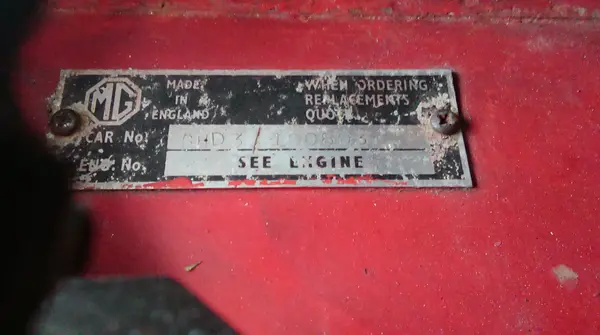 1962 to 1967 MGB Chassis plate
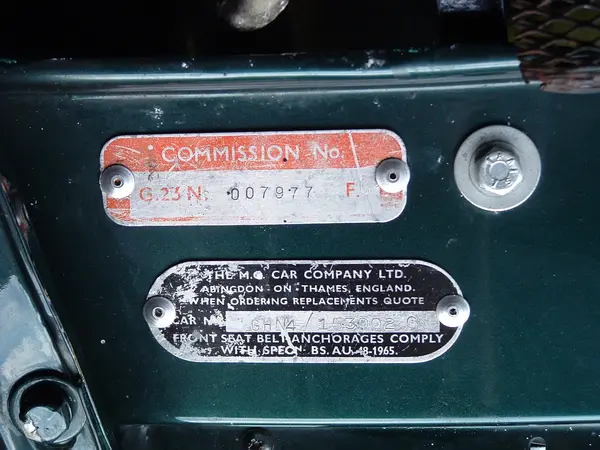 1968 to 1979 MGB Chassis plate and 1967 to 1976 Commission number plate.
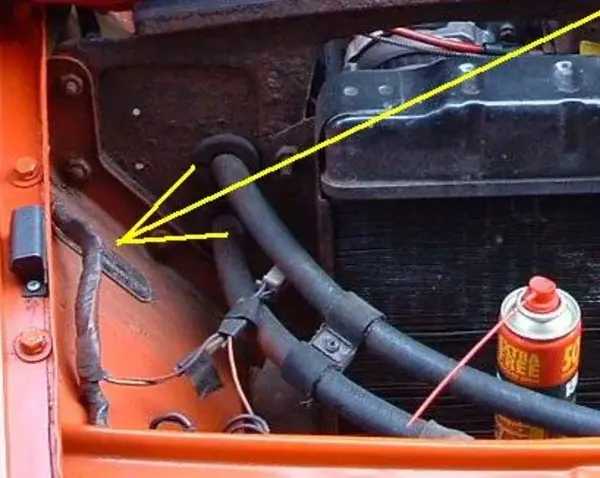 Original correct position of chrome bumper chassis plate.
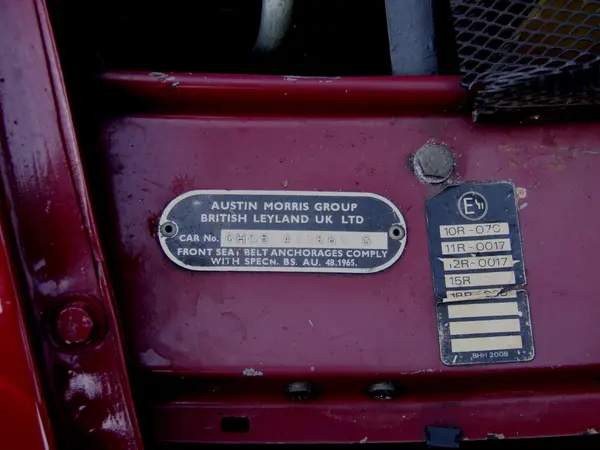 Mid 1970’s rubber bumper MGB chassis plate.
Now moving onto the MGB that was the second MG sports car to use unitary construction, (a monocoque) whilst the first was the Midget introduced in 1961 and the MG Z Magnette was the first MG. The identification of the cars continued to see the use of a separate chassis (frame or car) number and body numbers with the chassis number still being the most important form of ID. Looking at a typical early MGB Mk1 UK cars chassis number GHN3/5000 can be broken down as follows…
G = MG
H = engine capacity between 1400cc and 2000cc
N = two seat open top car (the GT used letter D)
3 = 3rd series (Note the MGB started with a 3 as it continued from the last MGA 1600 Mk 2 that used a 2)
5000 = this is the cars individual ID number
This format was issued to right hand drive Mk 1 cars from 1962 to 1967 although an additional L would be added after the 3 for all cars with left hand drive. In 1967 the L was reserved only for all non USA export left hand drive cars, whilst USA bound left hand drive cars now used the letter U.
In 1969 the use of the letter L was dropped and the cars bound for the USA gained a new letter after the U starting with an A that signified 1970 model year spec (not calendar year), then B for 1971 model year and changing every model year all the way to L for 1979 Model year spec.
In addition to the above changes in early 1967 the letter G was added after the cars individual ID number to signify the Abingdon assembly plant. When the Mk2 cars arrived in October 1967 the series number moved to a 4 for the following two years and then in September 1969 when the 1970 model year changes arrived the series number moved to a 5 that remained until June 1979 when the chassis number system was replaced by the VIN system for the final five months of MGB production.
Before moving to the VIN system its worth mentioning that the CKD kits that went for assembly in Australia used the prefix of the period GHN3, 4 or 5 but would have a Y in front of that, so for example YGH3 followed by the individual ID number. This was specific only to Australia.
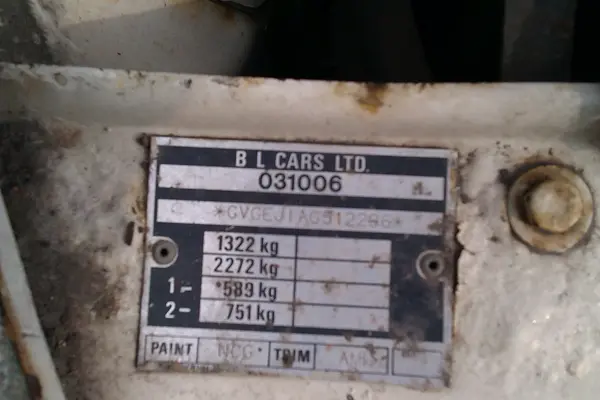 1979 and 1980 MGB VIN and plate.
The VIN used on an MGB (Image above) is quite different and has a standard format of fourteen characters and numbers that today has grown to seventeen. A typical UK market MGB roadster built between June 1980 and the close of the Abingdon factory on 22nd October 1980 would read GVADJ1AG519209 that can be interpreted as follows…
G = MG
V = Model range (MGB)
A = Base line spec
D = Roadster
J = 1800cc B series
1 = Steering and transmission - right hand driver and four speed manual transmission
A = 1980 model year (the model didn’t reach a later model year)
G = Abingdon assembly plant
519209 = the cars individual ID number
Variations on the above can be found at the third letter where the A can be substituted for any of the following…
G = Right hand drive GT
J = Japanese specification roadster (RHD)
L = Canadian specification roadster (LHD)
V = North American Federal specification roadster (49 States - LHD)
Z = Californian specification roadster (LHD)
The fourth letter for the body type D for roadster will change to an E for a GT
The sixth letter for steering and transmission that is a 1 for right hand drive four speed transmission will change to a 2 for a left hand drive car with four speed transmission.
MGC
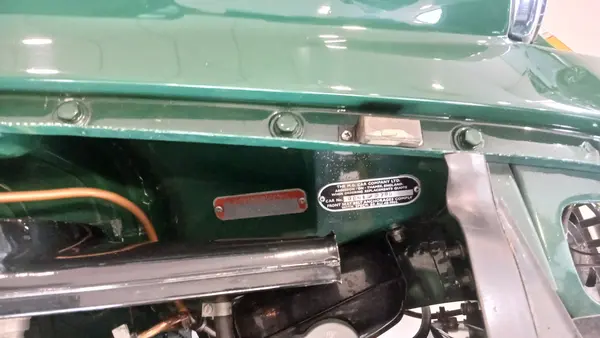 MGC chassis number and commission number plate and position.
Looking at the MGC that was produced between late 1967 and mid 1969 shows it to use a similar sequence as the MGB, so for example GCN1/1234/G applies to a UK MGC roadster that is interpreted as follows…
G = MG
C = 2912cc engine
N = two seat open top car (GT used letter D)
1 = 1st series
1234 = the cars individual number
G = Abingdon assembly plant
It’s worth noting that the letter C replaced the H with the MGC engine capacity of 2912cc, although this didn’t follow the usual BMC methodology regarding the correct letter for that engine capacity as it should have been a B that related to engines between 2000cc and 3000cc.
Next, the series number for the MGC only ever had 1 as it wasn’t in production long enough to make it to a second series. Like the MGB, left hand drive MGCs for the North American market would have a U following the 1 and left hand drive cars for other markets would have the letter L following the 1. Note, as MGC production ended in mid-1969 the changes to the chassis number system seen on the MGB in 1969 were not applied to the MGC.
MGB GT V8
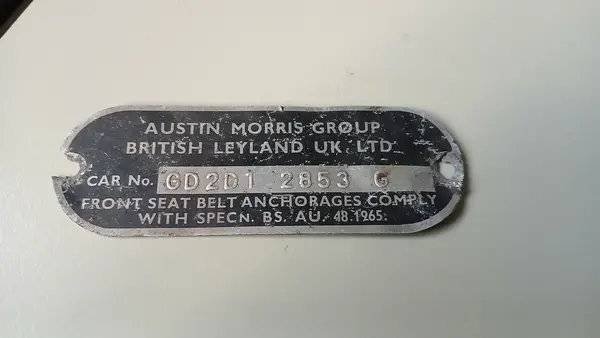 MGB GT V8 chassis plate
The MGB GT V8 has its own sequence and the example of GD2D1/1001/G is broken down as follows…
G = MG
D = Engine size 3528cc
2 = 2 door
D = Coupe body
1 = Right hand drive (2 applied to early Left hand driver examples)
1001 = The cars individual ID number
G = Abingdon assembly plant
Midget
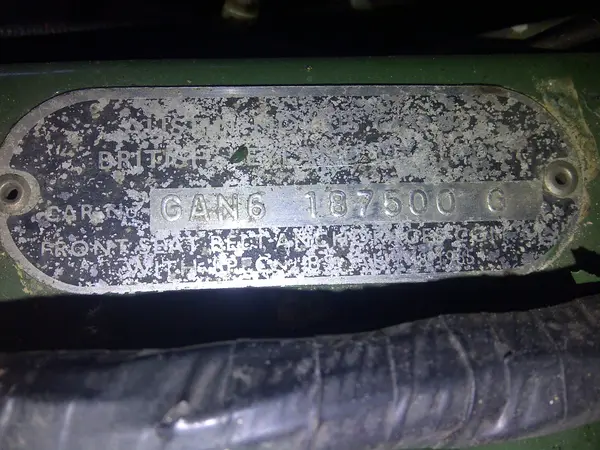 Rubber bumper Midget chassis plate.
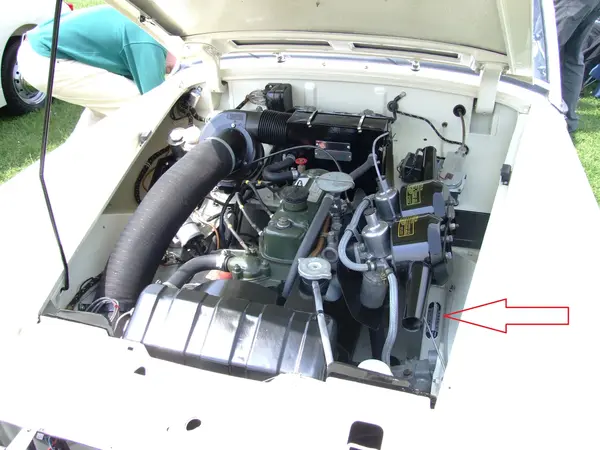 MG Midget chassis number plate position.
The Midget first appeared in June 1961 as a comprehensive development of the original Mk1 Austin Healey ‘Frogeye’ Sprite and whilst it was the first unitary (monocoque) construction for a BMC sports car it continued to carry separate chassis and body numbers with the chassis number being the most important. The format of the chassis number followed the then common BMC sequence with for example GAN1/1234 that can be interpreted as follows…
G = MG
A = engine capacity under 1200cc (i.e. the A series)
N = two seat open top car
1 = first series June 1961 to October 1962
1234 = the individual ID number
Midget identities can be a little confusing as there was until 1971 the parallel production Austin Healey Sprite that of course predated the Midget by three years with the ‘Frogeye’ Sprite. Its chassis prefix started with AN5 where the A and N had the same interpretation as above and the use of 5 for the fifth series was on the back of the Austin Healey brand having had four previous series of the Austin Healey 100 series cars.
When the facelifted Mk2 Austin Healey Sprite appeared in May 1961 (one month before the Midget Mk1) it used the same chassis number prefix as the previous Sprite but now with an extra H in front of the AN, plus the 6 being the next number on from the previous Frogeye Sprite, so now the Sprite chassis prefix was HAN6 that ran separately to the new Midget’s GAN1 prefix. In the following years as updates were applied to the cars they tended to be introduced at the same time and so this is why you find both HAN and GAN chassis numbers listed against the changes that does add a little confusion unless you have become familiar with the system.
Concentrating only on the Midgets GAN chassis number variations can be found all the way to the end of Midget production in 1979 and no the Midget never moved over to the VIN system as the MGB did. One oddity that commenced in 1966 was when the engine capacity was increased to 1275cc, yet the second letter A was retained, although that letter related to engine capacities only up to 1200cc and another letter should have applied. However when the 1493cc Triumph engine was fitted into the Midget in 1974 if the appropriate letter H for engine capacity between 1400cc and 2000cc was to be used then that would have created a conflict. The reason becomes obvious seeing that the letter H was already used on the MGB and immediately that would have created two different cars using the same GHN prefix, so the Midget stayed with the GAN prefix!
From the beginning of 1967 and in line with the MGB the letter G was added after the cars individual ID number to signify it was assembled at the Abingdon MG plant, which applied to most Midgets but for the few cars assembled at Cowley their chassis plate carried the letter M (for Morris).
Looking at the variations that were used for the Midgets chassis numbers shows that for the UK home market only the series number would change aside, obviously, from the sequential numbering of the individual cars ID. So the variations in the series number can be seen as follows…
2 = second series – October 1962 to March 1964
3 = third series – March 1964 to October 1966
4 = fourth series – October 1966 to October 1969
5 = fifth series - October 1969 to September 1974
6 = September 1974 to December 1979
However for export cars there were more changes, many of which were the same as applied to the MGB, for example all left hand drive cars would have an additional L added after the series number for all cars with left hand drive. In 1967 the L was reserved only for all non USA export left hand drive cars, whilst USA bound left hand drive cars now used the letter U.
In 1969 the use of the letter L was dropped and the cars bound for the USA gained a further letter after the U starting with an additional letter that signified the cars model year not calendar year. It started with an A for 1970 model year, then B for 1971 model year and changing every model year all the way to an L for 1979 Model year spec. The emphasis on model year rather than calendar year is because the changes were erratic, sometimes lasting for less than a year and sometimes much longer with many model year changes occurring in the summer period.
General information
An invaluable document for any classic MG owner is what is known as the ‘Heritage Certificate’, issued by the British Motor Museum and which contains details taken from the original MG factory production records and all cross referenced by using an individual cars Chassis number (remembering that the production records were made long before the cars got a registration number). The Certificate will in almost every case also record the engine and other numbers such as a body number and where date appropriate the Commission number.
For owners who want to find out as much detail as possible about their car then there is no substitute for the book,Original MGB with MGC and MGB GT V8’ by Anders Ditlev Clausager. It’s still in print and provides the most comprehensive listing of the detail changes that occurred during the MGB production period. It’s ideal for owners looking to return their cars spec to as close as possible to that which it had when it emerged from the MG factory at Abingdon.
With classis MGs being of significant age now it’s quite common for original alloy identity plates to have become quite degraded and as such a high proportion of classic MGs are restored to high standards it follows that owners often want to renew their cars identity plates. Some owners still incorrectly feel that doing so is unlawful, which stops them from doing anything. Only the chassis number is officially allocated in the DVLA record to that car and there is nothing to stop an owner from replacing the plate that displays that number as long as the same number is displayed on the replacement plate. Other numbers on other plates do not have the same significant importance, although they will always remain part of the cars history and so should be retained on the car where possible.
There are times when replacing an identity plate is not recommended, such as when buying a car that has been in a barn for decades and there is no record of the original registration number, or DVLA has no record of any number that is still on the car. Here it is always best to leave the car in its as found condition as original plate’s still showing numbers are invaluable evidence that these were original numbers for that car. Until you have the car registered such original evidence is invaluable in getting through the registration process that often includes inspection of the car when newly attached identity plates raise the wrong suspicions. The same scenario also applies to restoration project cars imported back into the UK. This helps avoid issues where the identity is questioned and a DVLA VIN and even Q plate could be issued.
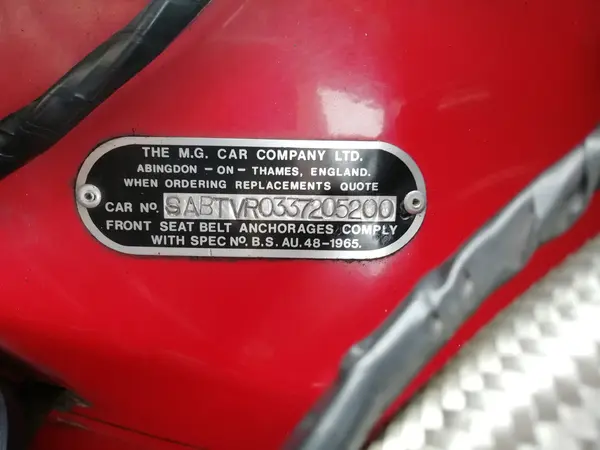 MGB issued with a DVLA VIN number.
MGOC Spares can supply most plates for example:
Correct stamping for full authenticity can be done by specialists although this really only applies to the post 1967 era when reverse stamping was applied, earlier cars had frontal stamping that commonly available stamping kits can do.
See our full range of classic MG components here. For further information contact our helpful sales advisors by phone on +44 (0)1954 230 928 or email at sales@mgocspares.co.uk.
Please Note: The information provided in this blog is intended as a general guide only. While we aim to ensure accuracy, classic vehicles can vary, and procedures may differ depending on model and condition. Always consult your vehicle’s official workshop manual before carrying out any work. If in doubt, seek the services of a qualified professional.
© 2025 MGOC Spares Ltd. All rights reserved.
This blog and its contents are the intellectual property of MGOC Spares Ltd and may not be copied, reproduced, or republished without prior written permission.
For author enquiries, corrections, or reproduction requests, please contact: blog@mgocspares.co.uk
Meet Roger Parker – our MG “Tech Guru” with a lifetime of passion for all things MG!
From his early experiences with MGs, to a career as a traffic officer developing ANPR systems, advising MG Rover and then as a technical advisor & writer at the MG Owners’ Club – Roger has worked on hundreds of MGs. Now, in “retirement,” he shares his unrivalled knowledge with us at MGOC Spares.
His blogs (exclusive & free!) are packed with expertise you won’t find anywhere else.
View more here
Who are MGOC Spares?
At MGOC Spares, we provide dedicated parts and accessories for classic MG vehicles, including the MGB, Midget, MGC and many more.
With thousands of products in stock, we are your one-stop shop for all your classic car needs. Our wealth of expertise means that you can trust us to find the right part for your classic MG vehicle – whatever it may be.
Need support finding the right parts for your MG?