
The Question
We have a very intermittent violent MGF clutch judder, the vehicle can be used for several days and clock up quite a lot of mileage without a fault, it runs exceptionally well, and then for no reason when pulling away it has this judder, we think it is the clutch but are open to suggestions. If you stop and take it out of gear for a moment and then take off again, most times the judder has gone. This fault is most likely to happen when hot, but not always.
It’s a very low mileage car with no obvious clutch faults or running issues, we have renewed the clutch slave cylinder and changed the fluid, the clutch operation arm is free with no sign of binding, this has made no difference.
I have spoken to other owners and a couple have also experienced the same fault, but no one knows why.
Any ideas?
The Answer
Clutch judder is usually caused by the clutch components and the flywheel not meeting concentrically or mating cleanly. Juddering is often the clutch plate material showing variable friction qualities so it is effectively gripping and slipping that generates the judder, which may be amplified by other conditions such as oil contamination or worn engine mountings.
There are a number of possible causes that are primarily focussed on the clutch and flywheel, but there are outside influences that can be quite impactful. Starting with a focus on the clutch itself brings the first possible cause to be oil contamination of the clutch plate which will create variable friction qualities! With oil contamination, you would expect to have a lot more oil leaking with only a small amount able to get on the clutch. In which case, the first obvious check point is the lower connection where the gearbox meets the engine, looking for oil drips.
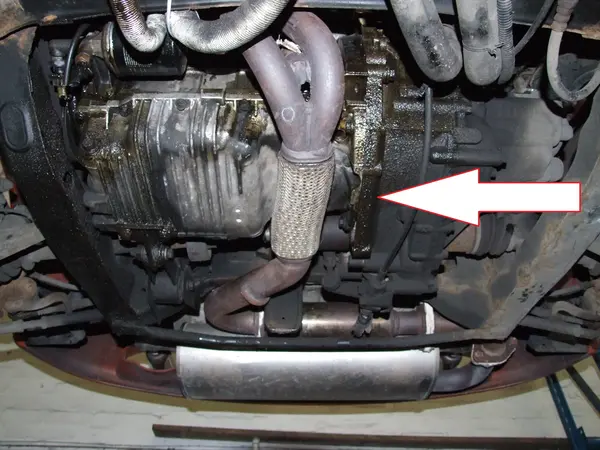 If oil contamination is the cause of clutch judder, then expect to find the arrowed area between the engine and gearbox underneath to be wet with oil. However, also check on top of the gearbox in case this is oil leaking and running down from the cam cover or cam seal.
Unlike models such as the MGB where there is a drain hole with a split pin in it to keep it clear - specifically as a drain point where you would often expect to see oil drips - the K series doesn’t have one. The join between engine backplate and gearbox clutch housing is not a fully sealed one and so any oil leaking into the clutch housing area will collect at the lowest point and start to pass through the join to give a clear oily surface visible from the outside. To get an idea where any oil may be coming from, the general guide is that oil from the engine would always have a darker colour to it from combustion deposits colouring it, compared to a gearbox oil leak whose oil will always retain its straw colour.
One point about an oil contaminated clutch plate is that it would create a much more frequent judder situation than you are reporting. This means that oil contamination is less likely as a cause, but there is another possible clutch plate cause that I have personal experience of and it can be dated back to the first 2.0 litre Montego’s which were the first users of the PG1 gearbox in 1984.
This PG1 specific clutch drag was found to be slight clutch driven plate distortion, so when depressing the clutch pedal fully and selecting first when stationary was difficult without baulking. When trying to select the unsynchronised reverse would generate crunching gears, unless you first selected fourth and then quickly went across into reverse. The best solution then and today is of course a new three piece clutch assembly.
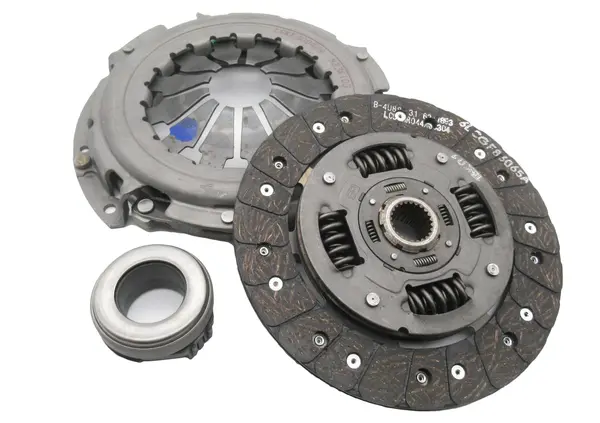
URF000160 - 200mm Clutch Kit for MGF/TF
As in this case, the judder is such an infrequent occurrence and the overall mileage so low that these faults are less likely to be contributing in this case, but can’t be completely eliminated. I would start with clutch driven plate springs weakening or breaking. Built into the clutch plate are a series of springs that are basically shock absorbers to soften the harshness of clutch engagement. Weakening or broken springs unbalances that function and can see the clutch engagement judder.
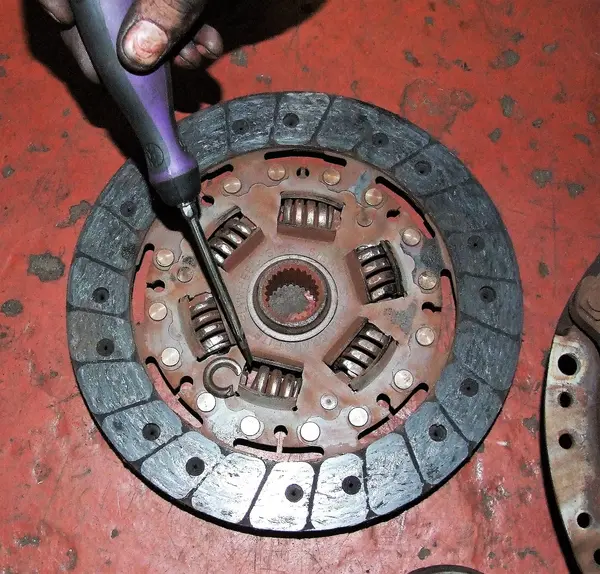 Broken clutch plate springs as indicated by the screwdriver will cause judder. Note that these clutch plate linings are well worn and the remaining springs have also been rubbing and become damaged, but not yet broken. (This clutch was well past its sell by date and surprisingly it still worked!!)
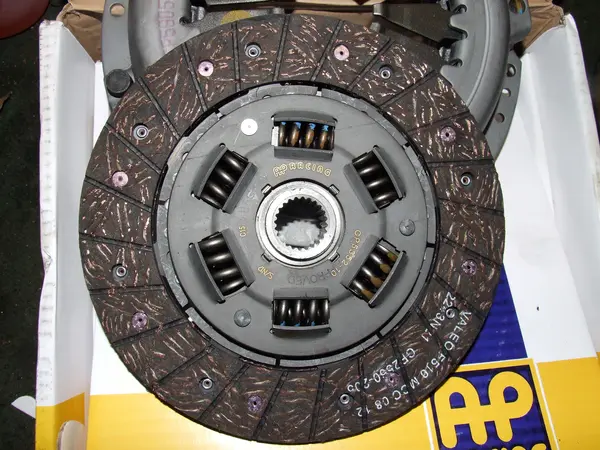 For comparison this is a new clutch plate. This can be seen to have more friction material than the worn plate as it is a 228mm diameter plate rather than the standard mainstream 215mm diameter.
Outside the clutch housing, worn engine or gearbox mountings is a common cause as they can allow too much engine/gearbox movement during the clutch engagement, setting up judder. Checking for excess engine/gearbox movement, especially the lower rear mounting that bolts to the alloy sump, is where I would expect to see only a very small amount of engine twist against the compression of the rubber. When looking at the engine, have someone else slowly put the drive train under load by engaging a gear and starting to engage the clutch. If the engine moves more than an inch this is something that has to be checked out. Also if you have heard any knocking from behind when the problem is present, then this is a very good indicator towards worn mountings.
Please note that one possible cause of judder sometimes suggested, is a failing dual mass flywheel, as this is a common problem on many modern cars. However, cars with the PG1 gearbox do NOT use a dual mass flywheel so can’t suffer this problem. Whilst PG1 equipped MGs and Rovers do not used a Dual Mass Flywheel the MG ZT range does.
Perhaps surprisingly, the gearbox input shaft that carries the clutch doesn’t have its front end sitting in a supporting spigot bush within the back of the engines crankshaft. So, it is possible when the input shaft bearing becomes worn and isn’t holding the shaft as securely as it should, it can allow more movement which could generate judder. That of course is a gearbox out to replace, but wear here and the work involved in removing the gearbox would make a full gearbox reconditioning or replacement a more sensible option.
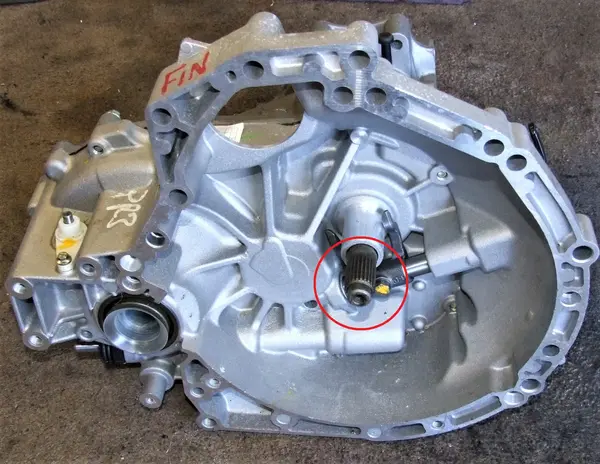 The PG1 input shaft circled doesn’t have its front end inserted into a crankshafts spigot bush like many gearbox configurations, so relies on its support from the input shafts main bearing mounted directly behind the main gearbox case and could move more if that bearing was worn.
Overall, with the age of the TF today I expect the issue is clutch based and will only be completely cured with a new three piece clutch being fitted. I would stress that before committing to a replacement clutch, that the other checks I mention regarding the engine/gearbox mountings should be done first. A clutch change is quite a big job and also disturbs the gearbox engine mounting, so if there is mounting wear, it makes sense to replace these as part of the overall job.
Looking for more MGB parts? View our full range HERE.
Please Note: The information provided in this blog is intended as a general guide only. While we aim to ensure accuracy, classic vehicles can vary, and procedures may differ depending on model and condition. Always consult your vehicle’s official workshop manual before carrying out any work. If in doubt, seek the services of a qualified professional.
© 2025 MGOC Spares Ltd. All rights reserved.
This blog and its contents are the intellectual property of MGOC Spares Ltd and may not be copied, reproduced, or republished without prior written permission.
For author enquiries, corrections, or reproduction requests, please contact: blog@mgocspares.co.uk
Meet Roger Parker – our MG “Tech Guru” with a lifetime of passion for all things MG!
From his early experiences with MGs, to a career as a traffic officer developing ANPR systems, advising MG Rover and then as a technical advisor & writer at the MG Owners’ Club – Roger has worked on hundreds of MGs. Now, in “retirement,” he shares his unrivalled knowledge with us at MGOC Spares.
His blogs (exclusive & free!) are packed with expertise you won’t find anywhere else.
View more here
Who are MGOC Spares?
At MGOC Spares, we provide dedicated parts and accessories for classic MG vehicles, including the MGB, Midget, MGC and many more.
With thousands of products in stock, we are your one-stop shop for all your classic car needs. Our wealth of expertise means that you can trust us to find the right part for your classic MG vehicle – whatever it may be.
Need support finding the right parts for your MG?