
The Question
I have just bought a 2003 TF 135 in a really, quite good condition for an over twenty year old car, but the exhaust, which amazingly, I think is original, is looking a bit grotty and I want to change it for a new stainless steel one. I can see that the original mounting studs at either end of the catalyst flanges are severely corroded and I am going to have to cut, grind and drill the remains of the stud and replace with new nuts and bolts. But, what is this valve that is on the right hand tail pipe just behind the rear bumper? It reminds me of a Turbo wastegate, but is clearly part of the original exhaust and every new exhaust I see doesn’t have this. What is the best route to change the exhaust?
The Answer
Yes, MGF and TF exhausts have lasted very well as the engine heat is close to the silencer and so keeps it relatively free of condensation which generates the usual exhaust killing corrosion. When the TF was launched in January 2002 part of the new cars specification in the TF 135 and TF 160 models (not the 115 or 120 models), was a vacuum operated ECU controlled throttle valve in the right hand tail pipe, and the MG ZR 160 was similarly equipped. This was to ensure that these two models with the most powerful engine specs in the TF range were able to pass the ‘drive by noise tests’ required as part of the cars Type Approval. Essentially by cutting out the flow of exhaust from the right hand tail pipe the exhaust noise was reduced and would guarantee it was below the legal threshold.
This was described as a ‘dual mode silencer’ and over time and miles it was expected that the valve would eventually seize up, but in the open, non-restrictive position, and pertinently Type Approval only related to the need for MG Rover to build the car to that compliant spec, the future serviceability of the valve is not subject to any checking.
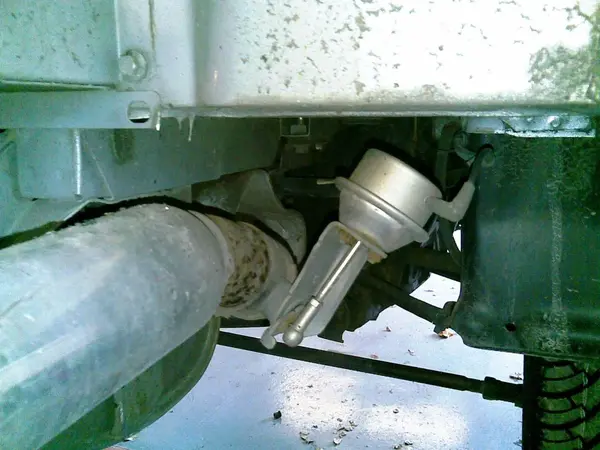 The ‘Dual Mode’ silencer used on pre mid 2004 TF 135 and TF 160 (bumper removed).
The actual operation of the valve was quite interesting as it wasn’t closed all the time and when there wasn’t any vacuum then the valve would naturally rest in the open position to provide the best and least restricted exhaust flow, but when the engine was running, vacuum would be collected in a reservoir mounted in the engine bay and this was connected to the valve on the exhaust via another valve which was controlled by the engine ECU.
 TF vacuum reservoir (red arrow) and ECU controlled valve (green arrow) sitting on the shelf on the right side of the engine bay, engine cover removed.
This was the status quo until June 2004 when from VIN RD631656, the dual mode valve was deleted and a new silencer without the valve was introduced to production cars that were able to pass the ‘drive by noise test’. This became the standard replacement for earlier TF 135 and TF 160 models which had the valve along with a recommended process to deal with the now redundant vacuum and control system associated with this deleted valve.
 The vacuum port connection on the engines inlet plenum chamber. This is a ZR160 as it allows a better view of the connection than on the identical TF 135 and 160 models.
The official process was to buy the new exhaust silencer and a small rubber blanking plug (LMF000060) which is nothing more than a plug end for the vac stub from the inlet manifold plenum. Next, the advice was to disconnect the vac feed from the plenum to the vac reservoir, fit the blanking plug and systematically remove the reservoir and pipes down to the valve on the tailpipe. Note that the control valve should be left in place, specifically with the electrical plug connection still attached as disconnecting it ‘could’ generate a fault code within the ECU. The vac pipe stubs can be left open as the valve now only needs the electrical connection to the engine ECU.
Commonly, the simple route has been to just replace the silencer with a new stainless steel one (Standard or Supersports) and to simply disconnect the vac pipe from the exhaust valve on the old exhaust and screw in a self-tapping screw into the rubber end to seal it and just secure the pipe to stop it flapping about. Leave the rest of the system in place. The deletion of this valve has no impact on the efficiency, economy or power delivered by the engine.
 TF vac connection line to exhaust valve plugged with self-tapping screw and secured to the panel to prevent it flapping about.
As you’ll see, MGOC Spares offer both Standard and Supersports exhaust options. Choosing between them isn’t always easy without hearing each system from inside and outside the car. Many owners have found the Supersports a little more vocal once fitted, so it’s worth considering how you use your car and the kind of driving experience you prefer.
If your MG has other performance modifications, the Supersports may complement those upgrades well. However, for a largely standard car — or for those who prefer a more refined note — the Standard system is often the better fit. It’s also worth remembering that exhaust systems are long-term purchases. In years to come, will you still enjoy a louder note, or would you prefer something closer to original sound levels but with added character?
A final point on replacement exhausts: original factory systems have not been available for some time, so today’s market consists of aftermarket alternatives. Stainless steel systems will generally outlast the original mild steel versions, but sound characteristics can vary considerably. Since these systems are likely to last many years, choosing a tone you’ll be happy living with is important.
MGOC Spares stainless steel exhausts are manufactured by the highly respected Double S, a long-established name in quality exhaust production. Their two options cater for different preferences — whether you favour a subtle, sporty enhancement or a more pronounced performance note.
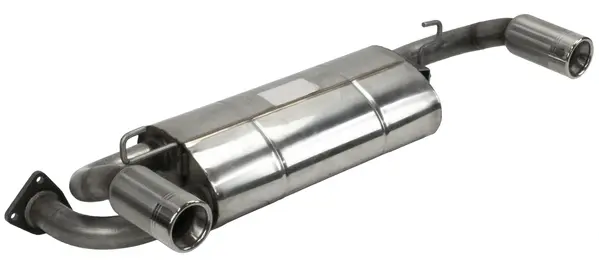 B136 - Stainless Steel Exhaust - Supersports - MGF & TF 2000 on.
When looking at replacing the main rear silencer on an MG TF (or MGF) the rest of the exhaust system will be at least the same age as the silencer, possibly older, and whilst the manifold rarely gives problems except in degrading threads for the stud connections to the downpipe, the downpipe usually suffers degrading flexible joints, and the remaining studs into the catalyst and out and into the rear silencer flanges often also degrade. All of these parts are available from MGOC Spares here.
Looking for more MGF & TF parts? View our full range HERE.
Please Note: The information provided in this blog is intended as a general guide only. While we aim to ensure accuracy, classic vehicles can vary, and procedures may differ depending on model and condition. Always consult your vehicle’s official workshop manual before carrying out any work. If in doubt, seek the services of a qualified professional.
© 2025 MGOC Spares Ltd. All rights reserved.
This blog and its contents are the intellectual property of MGOC Spares Ltd and may not be copied, reproduced, or republished without prior written permission.
For author enquiries, corrections, or reproduction requests, please contact: blog@mgocspares.co.uk
Meet Roger Parker – our MG “Tech Guru” with a lifetime of passion for all things MG!
From his early experiences with MGs, to a career as a traffic officer developing ANPR systems, advising MG Rover and then as a technical advisor & writer at the MG Owners’ Club – Roger has worked on hundreds of MGs. Now, in “retirement,” he shares his unrivalled knowledge with us at MGOC Spares.
His blogs (exclusive & free!) are packed with expertise you won’t find anywhere else.
View more here
Who are MGOC Spares?
At MGOC Spares, we provide dedicated parts and accessories for classic MG vehicles, including the MGB, Midget, MGC and many more.
With thousands of products in stock, we are your one-stop shop for all your classic car needs. Our wealth of expertise means that you can trust us to find the right part for your classic MG vehicle – whatever it may be.
Need support finding the right parts for your MG?