
The Question
I have a Mk1 MGB Roadster and I am seeing a regular small loss of coolant out of the overflow pipe and under the car once the engine is switched off after it’s got fully warm with a few miles driving. My temperature gauge doesn’t show any change from the steady seven o’clock position. It holds when the engine has warmed up and the heater is as inefficient as most MGBs so nothing out of the ordinary, but the constant dribble of about a full tea cup on the ground after every run is worrying. Could the radiator be restricted or blocked?
The Answer
The chrome bumper MGB always suffered from this sort of problem to some degree because there is no separate sealed expansion tank. This was introduced from mid-way through rubber bumper production when the radiator was changed to the forward mounted type. The function of the expansion tank is simply to allow coolant to expand whilst keeping it within the sealed cooling system. The earlier cars radiator had to provide this function within the top of the radiator.
Now what makes life difficult, especially so for the Mk1 MGB with the rear offset filler neck is you have absolutely no view into the rad to be able to see the level of the coolant. So when topping up, the only guide is when you see the coolant level reach into the filler neck. However, that is usually a little too high and doesn't leave enough room for the coolant to heat and expand in the top of the radiator during normal running conditions. So, even systems running at 100% efficiency will spit out a certain amount of coolant once the engine gets up to normal operating temp, just as you have described. At this point, when the car is parked, no air flows through the radiator and for a few minutes after engine stopping, temperatures rise a little above normal and with a little extra expansion coolant is spat out via the overflow. If you have a policy of topping up after every trip to compensate for the loss of coolant, you may be in a vicious circle.
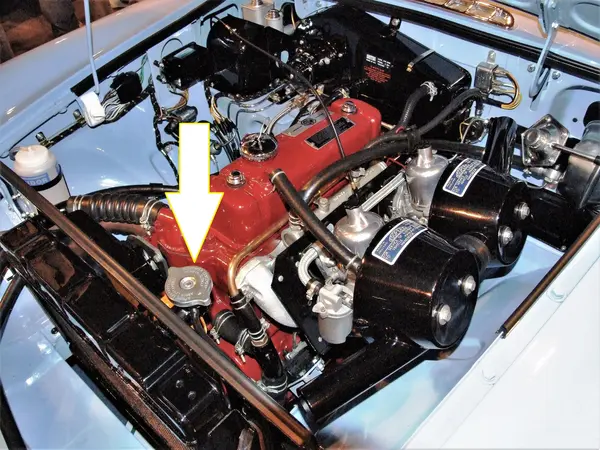 1962 to late 1967 radiator with the ‘Rear fill’ configuration
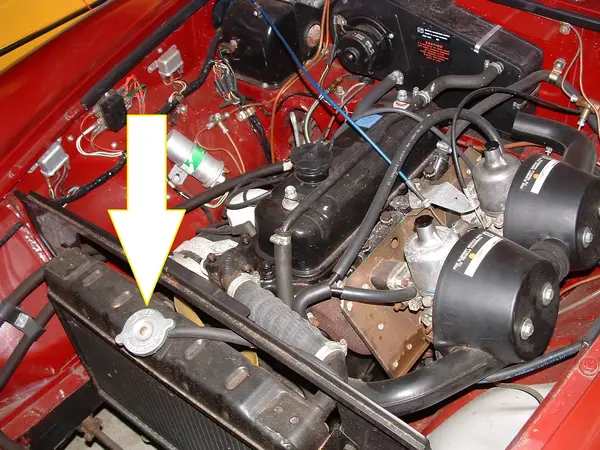 1968 to 1976 radiator with the ‘Centre fill’ configuration
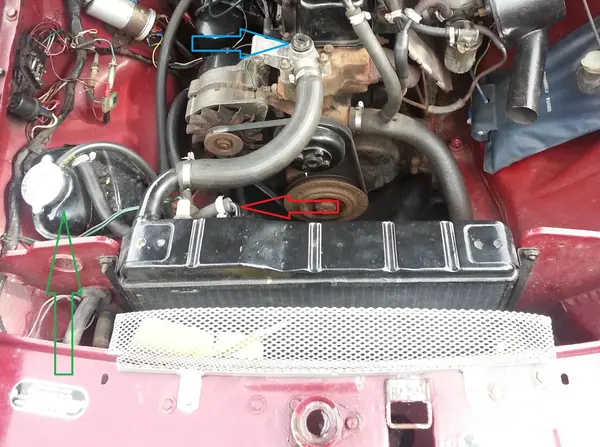 1977 model year and later cars moved to a sealed cooling system. The green arrow shows the expansion tank. The Blue arrow for the new cooling system fill point and the red arrow for the bigger bore and more secure connection between rad and expansion tank. Note early radiator overflow pipes are unsuitable to be converted to expansion tank connections.
To break that circle, put a collection bottle on the end of the overflow pipe to catch all of the ejected coolant so you can monitor the loss rate. Over the course of several trips, resist the temptation to top up and note whether the loss slows down and when it stops. This is what can be expected when all else in the cooling system is correct as this is just the coolant finding its natural level to leave the required expansion room in the top of the radiator. This settlement should approximate to losing between two to four cups of coolant in total over that settlement period. However, if the coolant loss doesn’t slow down then there is a problem.
The most common problem being that the radiator pressure cap isn't working properly. Either the seal or spring is damaged, aged or faulty and allowing coolant to leak out when it should be contained. A replacement cap is the first obvious move to try and early cars (1963-67) ran with a 7psi rated cap. However, on these radiators there can be a difference in the depth of the cap compared to the depth in the rad. Be sure to check the depths of both accurately to ensure that the cap reaches the seat in the rad neck and that it doesn’t leak as damage and distortion here isn’t unheard of. Note that antifreeze and other coolants like 4Life will leave tell tale, dried and coloured stains to point you to leaks.
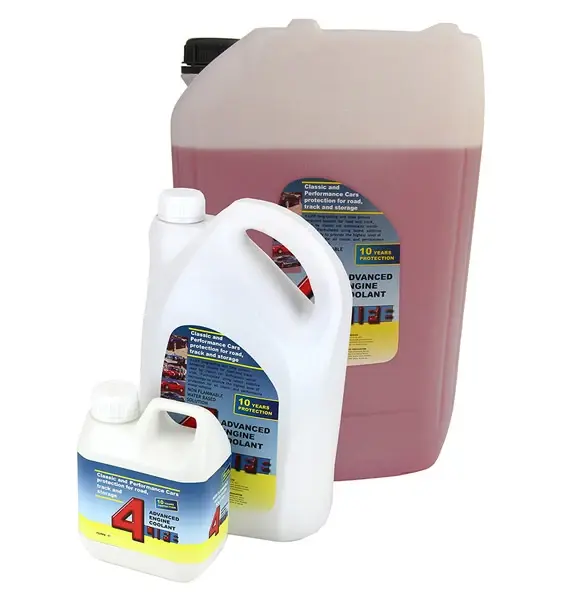 4Life Radiator fluid
Over time, the seat in the radiator's filler neck where the cap seal fits and/or the tangs which the cap locks into can become worn or distorted and that can cause reduced sealing properties and greater loss. Depending on the extent of the damage, this might then mean a replacement rad or specialist radiator company repair. Note repair costs of your existing radiator may exceed the cost of a new radiator.
Lastly, there is the possibility of pressurised combustion gas leaking from the cylinder(s) into the cooling system and raising the cooling system pressure higher than the caps resistance, so blowing coolant out on a continuous basis. Specialist water based coolant such as 4Life has an inbuilt marker that changes the colour of the coolant in the presence of combustion gasses. Of course, another option is the use of motor trade tests to assess coolant or the air above the coolant in the rad for traces of combustion gasses. The most common reason for combustion gas leaks is a failing head gasket. A compromised head gasket would also force coolant from the system in later cars with expansion tanks.
A blocked radiator would display different symptoms such as engine overheating which will be seen on the coolant gauge rising above the normal needle position. The "normal" needle position depends on the specific thermostat fitted and it's opening temperature. As a rule of thumb, you should expect the needle to sit at seven o’clock for the lower 74 degree C temp stat rating or six o’clock for the 82 degree C thermostats. Additionally, restricted radiators may well have ‘cold’ spots when feeling the reverse side of the rad on a warmed engine.
Another possible indicator of a less than efficient radiator is if you see the gauge needle readily rise above normal when in slow moving traffic, then slowly dropping when you get to a steady 50mph cruising speed. This occurs when airflow through the radiator is significantly increased. The engine is not having to work as hard and not generating much heat, so a clear rad would lose heat from the coolant much faster.
Cleaning a blocked radiator is usually destined to fail as blockages usually implies it is past the point of reasonable recovery. A partly restricted rad might be recoverable by using a radiator flushing additive followed by removal from the car and back flushing. However, experience shows this is usually only a ‘band aid’ type of exercise which simply buys a little time for you to arrange for a new radiator or have the existing radiator re-cored by a specialist rad company.
Looking for more MGB parts? View our full range HERE.
Please Note: The information provided in this blog is intended as a general guide only. While we aim to ensure accuracy, classic vehicles can vary, and procedures may differ depending on model and condition. Always consult your vehicle’s official workshop manual before carrying out any work. If in doubt, seek the services of a qualified professional.
© 2025 MGOC Spares Ltd. All rights reserved.
This blog and its contents are the intellectual property of MGOC Spares Ltd and may not be copied, reproduced, or republished without prior written permission.
For author enquiries, corrections, or reproduction requests, please contact: blog@mgocspares.co.uk
Meet Roger Parker – our MG “Tech Guru” with a lifetime of passion for all things MG!
From his early experiences with MGs, to a career as a traffic officer developing ANPR systems, advising MG Rover and then as a technical advisor & writer at the MG Owners’ Club – Roger has worked on hundreds of MGs. Now, in “retirement,” he shares his unrivalled knowledge with us at MGOC Spares.
His blogs (exclusive & free!) are packed with expertise you won’t find anywhere else.
View more here
Who are MGOC Spares?
At MGOC Spares, we provide dedicated parts and accessories for classic MG vehicles, including the MGB, Midget, MGC and many more.
With thousands of products in stock, we are your one-stop shop for all your classic car needs. Our wealth of expertise means that you can trust us to find the right part for your classic MG vehicle – whatever it may be.
Need support finding the right parts for your MG?