 The Question
I’m planning to change the gearbox on my MGB from non-overdrive to an overdrive one. Do I also have to change the speedometer?
The Answer
Such a simple question, with multiple detailed answers, all revolving around the age of the car and the age of the gearbox/overdrive types that are fitted to different model years. As you do not mention the car’s age, that complicates the answer.
In very basic terms, yes, a change is needed, as the speedo calibration is different between the OD and non-OD cars. However, some of the complication arises as there are effectively three different specs of gearbox: chrome bumper three-synchro, chrome bumper four-synchro, and rubber bumper four-synchro.
To add to the complication, there are two distinctly different speedo types: the chrome bumper 4” (102mm) diameter item and the rubber bumper cars’ smaller 80mm diameter ones, and this is before looking at the different types of cable connection at the rear. However, when looking at the original parts lists, we see 20 different options for MPH speedos during the eighteen years of MGB production, with a similar number of KPH variants. All have slight differences, with some obvious ones in internal gearing, whilst others will have additional differences, such as a different face.
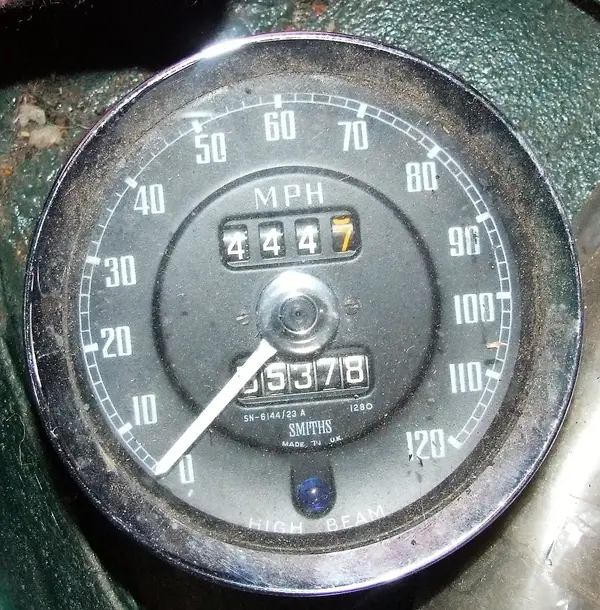
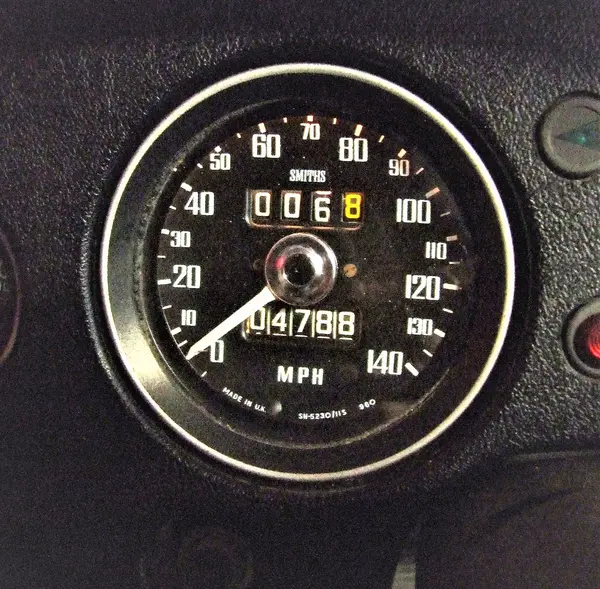
Chrome bumper 4” MGB speedo showing the SN serial number under the odometer and to its right, 1280 as the turns per mile indicating this was fitted to a 1968 on car with overdrive.
Take, as an example, a 1970 MGB; there is nothing particularly unique about the speedos found in this year compared to other MGB models. Here, there is a common difference in internal speedo gearing, with a non-overdrive speedo geared to around 1020 turns of the speedo cable for every mile (TPM), whilst the OD version has 1280 TPM. It should be obvious that a 25% difference in the number of turns per mile will have a significant impact on the speed displayed; this sort of variation can be found in other model years as well.
The MGB speedo is noted for its ‘common degree of optimism’ in its readings compared to actual speeds. UK law allows speedometer accuracy to be optimistic by up to 10% of the vehicle’s actual speed, plus 6.25mph, but it does not permit any under-read. The current legislation is an adoption of EU law and benefits the MGB’s speedo optimism in that pre-EU law in the UK only allowed a simple maximum over-read of 10%, so at 40mph that would allow up to 44mph to be displayed, but 45mph and over would be illegal. Now, with the added 6.25mph, the over-reading can be legal up to 50.25mph. The reason I say this is a benefit for the MGB is that its over-read was often over 10%!
When looking at earlier cars, generally there will not be any physical problem encountered in fitting an overdrive-geared speedo in place of a non-overdrive type, and only the small-print details will be different on the front lower face—the SN number specifically—and a different speed reading for the same engine rpm in the same gear.
Now, at this point, the one common issue that crops up regularly with these conversions is when an earlier four-synchro car is being fitted with a rubber bumper overdrive gearbox. Incidentally, you rarely see the fit the other way around, as overdrive was standardised on most rubber bumper cars for the UK in 1975 and many other markets, but notably not in the North American market. In contrast, the chrome bumper cars for the UK market saw overdrive as an extra-cost option, and its selection only started to become more common than non-overdrive in the last couple of years of chrome bumper production, leaving many more chrome bumper cars without overdrive.
The main point is, of course, that it’s not the actual gearbox fit that causes any problem, as the rubber bumper four-synchro gearbox fits straight into where the earlier four-synchro chrome bumper gearbox sat, but the speedo gearing is incompatible. Visual gearbox differences are seen, as the rubber bumper gearbox has no combined dipstick and oil fill point on the top of the gearbox casing, but instead has a combined filler/level plug on the right side of the gearbox case. Additionally, on the underside of the LH overdrive, there is a black printed ID label fitted to the solenoid cover for the chrome bumper cars and a blue printed label for the rubber bumper cars. (V8 models use a red printed label, and while the Sherpa van version is uncertain, it is likely to be blue, as it comes from the same period and shares similar gearing to rubber bumper MGs.)
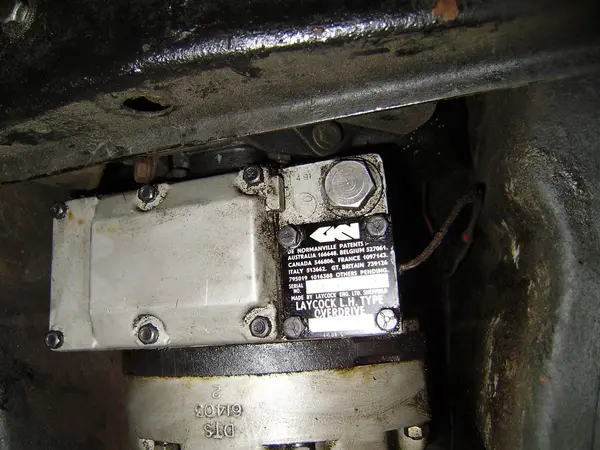 MGB all synchro LH type overdrive with black printed ID label
That different colour overdrive label also signifies that the speedo gearing inside is physically different in size, so there is no chance of mixing and matching. Identification is easy, as the chrome bumper MGB uses a white plastic speedo gear with 21 teeth, and the rubber bumper one is red with 20 teeth (see image that shows size difference). The significance here is that simply swapping this easy-to-remove pinion gear won’t work without the inner gear also being changed, and taking an overdrive to pieces to change the internal gear is not a realistic option compared with a speedo change.
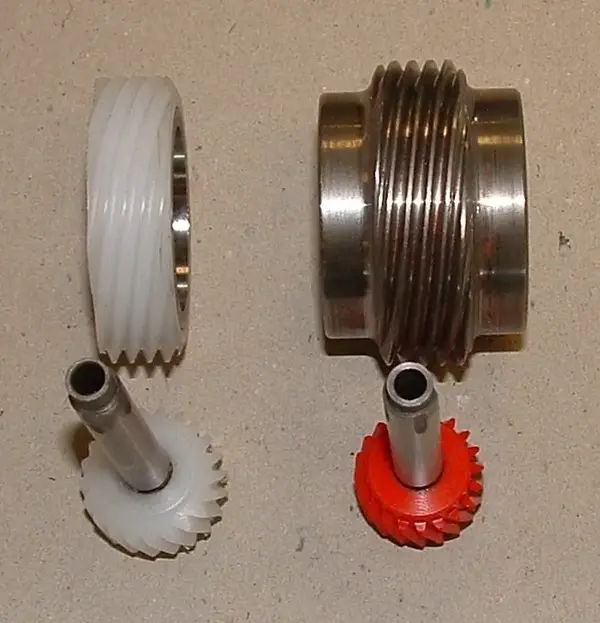 The all synchro chrome bumper speedo gears (white) left (37H3463 & 37H3464) and rubber bumper equivalents right (37H8845), note the dimensional differences.
However, a speedo swap to a rubber bumper speedo in a chrome bumper car isn’t an option either, as all rubber bumper cars used the 80mm diameter speedo, so it is 22mm smaller in diameter than the chrome bumper cars’ 4” (102mm) speedo aperture. Therefore, recalibrating a chrome bumper 4” speedo is usually the only sensible route.
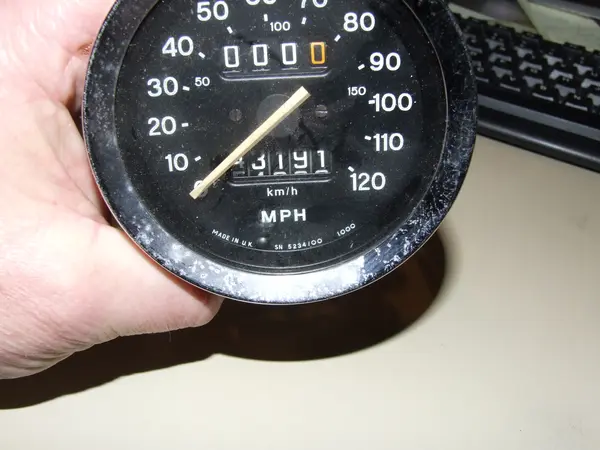 Rubber bumper 80mm standard speedo showing SN number and 1000 turns per mile, pointing to a non-overdrive car.
 Standard MGB GT V8 speedo showing 960 turns per mile calibration.
So far, I have focused on a 1970 model year car, and this sits in the Mk2 MGB area (1968–1974) with the later four-synchro gearbox, but what if your car is a three-synchro model, as far more cars didn’t have overdrive when these were made? Here, the speedo issues are less complex than finding a good three-synchro overdrive gearbox and working out the different propshaft lengths between non-overdrive and overdrive models (three different lengths), depending on whether the car has a Banjo or Salisbury axle fitted.
Even so, the chances of finding the OD version of the speedo for these early cars on the second-hand market are much smaller, and assuming you don’t, then most MG spares suppliers with the correct overdrive-spec speedo on their shelves would sell only on a like-for-like exchange basis, meaning your existing speedo has to be the same spec and SN number as the new one, which it is not. This means you are best off working with your existing speedo and having it recalibrated and reconditioned as required.
Recalibration is a far simpler route than may appear and is quite straightforward for a speedo specialist (MGOC Spares can offer this service), and the information needed by the specialist is relatively simple for an owner to gather, as can be seen on this website: Speedy Cables.
With the plethora of GPS devices today, this also provides an accurate tool for checking the accuracy (or inaccuracy) of an existing speedometer, and also the accuracy of any rebuilt/recalibrated speedo, as you always want to avoid the unintended attention of the multiple speed-measuring devices that are so common on our roads!
MGOC Spares offers a comprehensive range of original speedometers on a 141 (One for One) or COU (Customer Own Unit) basis. To view our full range of MGB Speedos, see our category here. For further information contact our helpful sales advisors by phone on +44 (0)1954 230 928 or email at sales@mgocspares.co.uk.
Please Note: The information provided in this blog is intended as a general guide only. While we aim to ensure accuracy, classic vehicles can vary, and procedures may differ depending on model and condition. Always consult your vehicle’s official workshop manual before carrying out any work. If in doubt, seek the services of a qualified professional.
© 2025 MGOC Spares Ltd. All rights reserved.
This blog and its contents are the intellectual property of MGOC Spares Ltd and may not be copied, reproduced, or republished without prior written permission.
For author enquiries, corrections, or reproduction requests, please contact: blog@mgocspares.co.uk
Meet Roger Parker – our MG “Tech Guru” with a lifetime of passion for all things MG!
From his early experiences with MGs, to a career as a traffic officer developing ANPR systems, advising MG Rover and then as a technical advisor & writer at the MG Owners’ Club – Roger has worked on hundreds of MGs. Now, in “retirement,” he shares his unrivalled knowledge with us at MGOC Spares.
His blogs (exclusive & free!) are packed with expertise you won’t find anywhere else.
View more here
Who are MGOC Spares?
At MGOC Spares, we provide dedicated parts and accessories for classic MG vehicles, including the MGB, Midget, MGC and many more.
With thousands of products in stock, we are your one-stop shop for all your classic car needs. Our wealth of expertise means that you can trust us to find the right part for your classic MG vehicle – whatever it may be.
Need support finding the right parts for your MG?